

Carpenter Ants In Omaha Since Beginning Of Time
Exterminators at Omaha Pest Control, Inc. have over 25 years experience with pest inspection, pest treatment and pest control of carpenter ants and other pests.
Omaha, Bellevue, and Papillion are a few of Nebraska cities in the center of the agricultural Midwest and center around the farms and crops that feed our world and provide employment for its citizens. Successful farming requires successful pest control, your home is no different. Pests can transmit disease and damage structures so pest management in your house is essential.
Carpenter Ants, Identification & Control
** The following information was provided by the University of Nebraska entomology dept.**
Carpenter ants are important in the balance of nature because they burrow and nest in dead trees and enhance decay of the wood. They achieve pest status when a colony invades and damages the integrity of the wood within a house. This educational resource explains how the biology and behavior of carpenter ants relate to control strategies when a homeowner is faced with this problem.
Homeowners may be concerned if they see carpenter ants inside. But, seeing carpenter ants inside the home does not necessarily mean the house is actually infested. It could mean the house is simply within foraging distance of a colony. Carpenter ants keep occupied galleries clean. They remove wood in the form of a coarse sawdust-like material, which they push from the nest. This often results in a cone-shaped pile accumulating just below the nest entrance hole. This pile may include, in addition to the wood fragments, other debris from the nest, including bits of soil, dead ants, parts of insects and remnants of other food they ate.
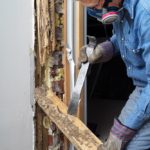
Carpenter Ant Control
Application Methods:
Baits: Colonies of some ant species can be controlled with baits because carpenter ants have such a varied diet, baits are not very successful.
Over the Counter Sprays: Spraying foraging workers with most insecticides is of limited value because, even though some workers will die, the colony will largely be unaffected by the treatment.
Treating the Ant Colony:
Because carpenter ants live in colonies a treatment which targets the colony will be most effective. Finding the colony is important. Look for the piles of sawdust to locate the entrance. Another method to find the colony is to watch the movement of foraging ants. Inspect the entire structure and surrounding grounds, because the nest may be outdoors.
Once you find the colony, control strategy depends on where it is. If the colony is in a tree, you can use a dust insecticide labeled for use on trees in the landscape. Apply the dust directly into the nest cavity. It may be money well spent to hire a pest control professional who has a greater arsenal of products at his/her disposal and proper application equipment.
Remember, the most effective carpenter ant treatments are those that target the colony. Some companies may propose expensive treatments which use more insecticide than is needed to control the carpenter ant problem.
Prevent Carpenter Ant Infestations:
Trim all trees and bushes so branches do not touch the house and correct moisture problems such as leaky roofs and plumbing. Paint and/or seal exposed wood construction before it becomes wet. Replace previously ant-or termite-infested wood, rotted or water-damaged wooden parts of the structure and eliminate wood/soil contacts. Remove dead stumps on the property and store firewood off the ground and away from the structure.
- Non-chemical Controls: Carpenter ant management involves eliminating moisture problems associated with interior colonies to correct conditions suitable for colony survival. Colonies can sometimes be eliminated by discarding infested wood or by vacuuming ants. In these situations, no insecticides may be needed.

Outdoor Carpenter Ant Colonies Need Treated
They may be the source of satellite colonies which invade wall voids during warmer months. Carpenter ants will not kill living trees, but openings in living trees are attractive to carpenter ants. These openings are likely to be entrances for carpenter ant colonies. For information on caring for damaged trees, contact a certified arborist.
Stacks of firewood and old dead tree stumps also attract carpenter ants. The longer wood remains undisturbed, the more likely it will become infested. It is best to only store firewood you plan to use during one heating season. Store wood on a concrete pad above the soil and away from the house. Spraying of firewood with insecticides is not recommended.
* University of NE Entomology *