
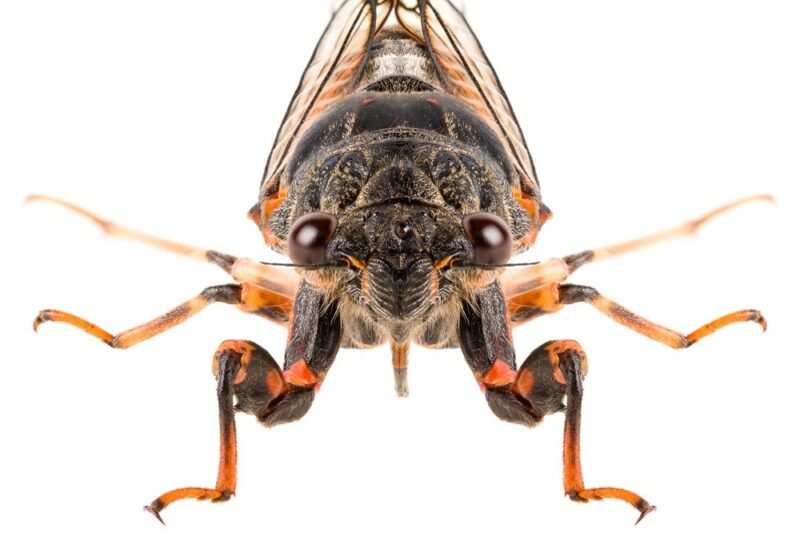
Cities In Nebraska Witness Cicada Killer Wasps.
Females construct burrows that are small wonders of engineering and effort. Several feet long, and featuring numerous individual brood chambers at their far end, they require the excavation of hundreds of times the insects’ own weight in soil. The female killers manage the feat in just a few hours, using only their jaws and hind legs.
After that they hunt, for the so-called dog-day cicadas. A killer paralyzes a cicada with a single sting, but getting it back to the burrow can be an all-day affair. It may be three times the killer’s own weight–too heavy to properly fly with. Instead she drags it up the nearest tree, then launches herself, prey in claw, and glides as far as possible toward her burrow. She may have to repeat the process half a dozen times.
Back at the burrow, she deposits the paralyzed cicada in a brood chamber. Then she lays an egg and carefully tucks it beneath the cicada’s foreleg, beside the puncture wound from her sting. (The doomed creature looks, creepily, like a wizened old man with a baguette tucked under his arm.) The female then seals the chamber with dirt, the cicada still living and immobilized within it. A few days later the egg hatches and grub begins to eat the cicada alive, using the puncture wood as an entry point. Later, the grub spins a cocoon, in which it metamorphoses into an adult wasp, emerging the following year.
Meantime, the males are trying to win mates. Each claims about a square yard of territory. But because the bare ground on which these territories are established is physically featureless, the boundaries are impossible for the other males to determine.

Cicada Wasps Are Top Predators
Aware of the danger, female cicada killers attempt to outwit these “satellite flies”–so named because they hover around the much larger wasps as if orbiting them–by dropping to the ground and remaining motionless for minutes at a time. Other cicada-killer antagonists go after the adults, spiking them with needle-like probes and sucking out their guts.
Unlike other wasp species that plague human summers, only the females of the cicada killers have stingers, and both their sting and their temperament are very mild. Instead, when threatened, they fly away or, if trapped in a burrow, frantically beat their wings against its walls, producing a loud rattlesnake-like whir.
Male cicada killers are entirely stingless, and though they do tend to brusquely approach anything that moves inside their territory, including people, they’re simply on the lookout for rivals and potential mates. Since humans are neither, they quickly break off their “attacks.”
Omaha Pest Control has many years of experience controlling these cicada killer wasps. Omaha, NE and its neighboring cities of Bellevue, Papillion, Elkhorn, Council Bluffs, IA and many others are affected.